
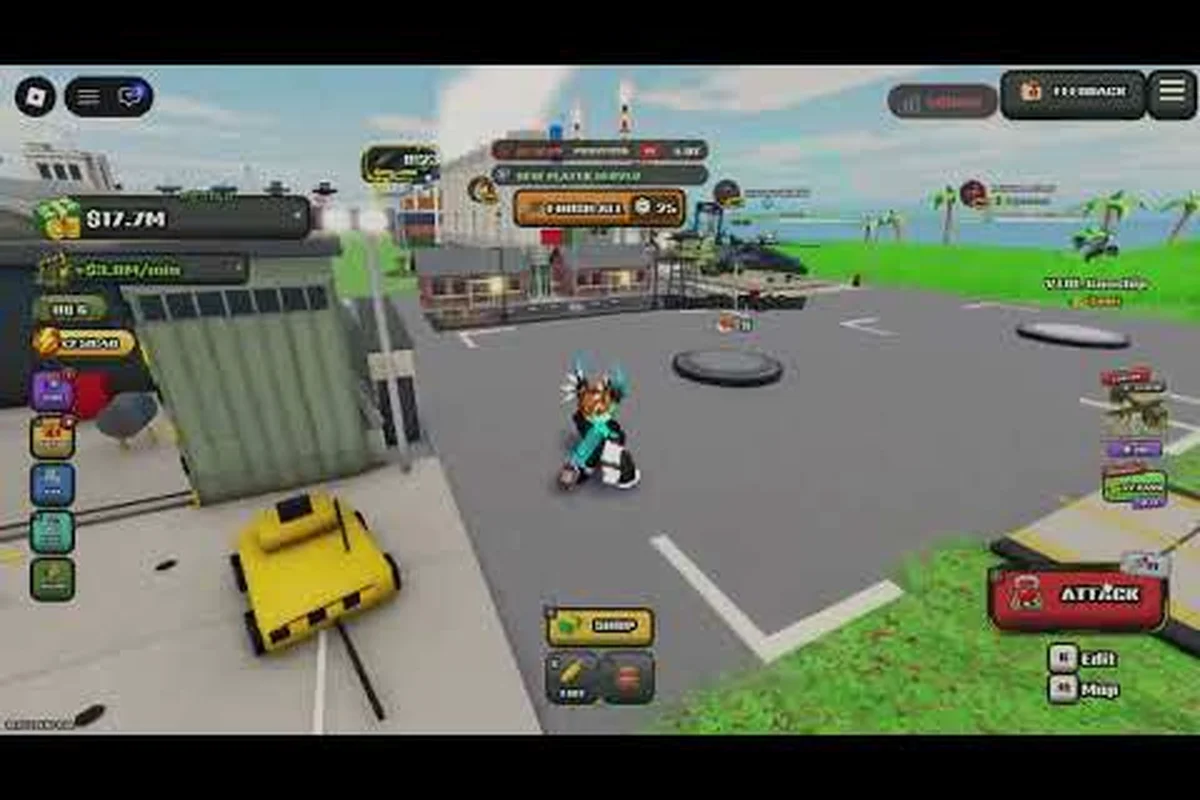
Every World of Nukes build guide eventually runs into the same wall: your tropical island is full, income has stalled, and the next land tile costs more than your whole setup earns. This guide fixes that by showing where to place structures, which upgrades pay back first, and how to unlock new land without burning cash you'll need later.
Why Placement Beats Raw Upgrades in World of Nukes
The single biggest mistake on a fresh island is buying upgrades before you understand spacing. Your starting island is a modest tropical base with limited land, and every structure you drop takes a slot you cannot get back without demolishing it. According to the official World of Nukes page, the core loop rewards keeping income structures close together so you cut travel time between collection points.
That detail matters more than it sounds. When your generators, storage, and collection points sit far apart, you spend real seconds walking between them, and those seconds compound across a session. A tight cluster of three income buildings often out-earns a spread-out set of five.
Here is how the three placement philosophies compare in practice: a tight cluster keeps your generators within a few tiles of storage and collection points, so each collection run costs only a couple of seconds and your income-per-minute stays high on the small starting island. A spread ring looks tidy but forces long walks between every building, wasting both land slots and collection time — which is why it is never recommended in a world of nukes build guide. The core + perimeter layout trades a little collection speed for defense room, letting you ring your income core with turrets once raids begin without demolishing anything.
| Layout Style | Income Speed | Land Cost | Best For |
|---|---|---|---|
| Tight cluster | Fast collection, short walks | Low, uses fewer tiles | Early and mid game |
| Spread ring | Slow collection, long walks | High, wastes tiles | Never recommended |
| Core + perimeter | Medium, protected | Medium, leaves defense room | Once raids begin |
| Layered grid | Fast, scalable | Medium-high | Late game expansion |
The takeaway is simple: cluster income first, expand outward second. Players who reverse that order usually end up demolishing buildings to make room, which refunds less than they paid — a demolition penalty that quietly drains the early-game cash you need to unlock new land. Concretely, place your first generators and storage within the tight-cluster footprint shown in the table above, bank the income-per-minute advantage, and only then spend toward the next land expansion. That sequencing keeps every tile productive and means the core + perimeter defense layer can be added later without tearing down a single income building.
The Travel Time Tax
Every tile between your income building and your collection point is a tax on your time. Community reports consistently describe the same pattern — new players build wherever the game drops them, then wonder why their cash per minute lags behind friends who started the same day. The fix is to treat your island as a grid and reserve the center for whatever generates money.
What to Build First
Before you spend anything on land, lock in this order: the game rewards a tight early footprint, and every tile you buy before your first income generator is online is a tile draining upkeep with nothing feeding it back. New players routinely blow their opening cash on a wide land grab — three or four scattered plots — then stall because no single structure has the adjacency bonus to pay for itself. The fix is sequencing, not spending: place your generator first so its output starts ticking immediately, then build outward only as each structure proves it can sustain the next unlock. Treat the first few minutes as a proof-of-concept run, not an expansion race.
-
One income generator placed dead center of your starting tiles
-
One storage structure directly adjacent, no gap
-
One collection point within two tiles of both
-
Nothing else until that triangle is running
That triangle is your engine, and everything after it is scaling. The reason is adjacency math: a generator with no adjacent storage vents surplus output, while a storage structure touching the generator banks that surplus so your collection point — within two tiles of both — converts it into spendable income without a second generator. Skip the triangle and you pay upkeep on three disconnected structures that each run at partial efficiency, which is exactly how a promising island stalls before the first land unlock. Get the triangle ticking first; only then does buying new tiles (and the land unlock that follows) multiply a working system instead of feeding a broken one.
Reading the Island Grid Before You Spend
Treat the island as a grid and the whole World of Nukes island guide becomes much easier to follow. Each tile has a fixed footprint, and buildings snap to it, so planning two or three tiles ahead prevents the demolition spiral that eats new players' cash.
A useful habit is to sketch your intended layout before you place anything. You do not need a tool for this — just decide which edge of the island will be your income side and which will be your defense side. Keeping those separate means you never have to choose between earning and protecting.
| Tile Zone | Purpose | Priority |
|---|---|---|
| Center | Income generators | Highest |
| Inner ring | Storage and collection | High |
| Outer ring | Defense and shields | Medium early, high later |
| Corners | Decorative or flexible | Lowest |
Spacing Rules That Save Cash
Leave a one-tile buffer between your income cluster and your outer ring. That buffer is where anti-air and shields will eventually go, and having it pre-cleared saves you from tearing down a generator later. The base defense layout breakdown explains exactly how much perimeter you need once raids start, but the short version is: plan for it now, build it later.
When to Demolish
Demolish only when a building physically blocks a better structure from fitting — for example, a tier-1 turret occupying the exact tile where a missile silo needs to anchor. If you are demolishing purely to reorganize, you already lost the planning battle at the island-building stage, since every placement should be mapped before you spend resources. The refund is partial, so each teardown is a small permanent loss that compounds across a run; three careless demolitions can quietly drain the equivalent of one early expansion unlock. Treat the demolish button as a last-resort fix for genuine footprint conflicts, not a layout tool.
World of Nukes Island Building Tips That Actually Move Income
Most World of Nukes island building tips you see repeat the same advice about upgrading everything. That is wrong early on. Upgrades scale off your base output, so upgrading a weak building wastes money that a second generator would have multiplied.
Focus your first three upgrades on whichever structure produces the highest base income per tile. Then stop and reassess. If your collection speed is the bottleneck, upgrade storage instead — a full storage building stops generating, which is the quiet killer of early progress.
| Upgrade Target | Cost Tier | Payback Speed | Verdict |
|---|---|---|---|
| Primary generator | Low | Fast | Buy immediately |
| Storage capacity | Low | Fast | Buy when storage fills |
| Collection speed | Medium | Medium | Buy after two generators |
| Decorative structures | High | None | Skip until late game |
| Land tiles | Scaling | Slow | Buy only when island is full |
The Storage Ceiling Trick
Storage buildings stop producing when full, and a full building is dead weight. Check your storage before you walk away from the game. If it fills in under five minutes of idle time, you need capacity more than you need another generator.
Stacking Income Without New Tiles
You can raise income without buying land by upgrading existing generators and tightening their placement. This is the core World of Nukes island building trick that separates fast islands from slow ones — squeeze your current footprint dry before you pay for expansion. The island building guide goes deeper into upgrade sequencing if you want the full order of operations.
How to Unlock New Land Without Wasting Cash
Land is the most expensive thing on your island, and the cost scales as you expand. That scaling is why players who buy land too early stall out — they spend their entire bankroll on a tile, then have nothing left to build on it.
The rule is straightforward: only buy land when your current tiles are fully utilized. Fully utilized means every income slot is filled and upgraded to the point where another upgrade costs more than a new tile would. Until then, land is a trap.
| Island State | Buy Land? | Reason |
|---|---|---|
| Empty tiles remain | No | Free space is cheaper |
| All income slots filled | Yes | Now land pays for itself |
| Storage full constantly | No | Fix storage first |
| Income stalled after upgrades | Yes | Expansion is the only lever left |
The Break-Even Check
Before every land purchase, ask whether the new tile will earn back its cost before you need the next one. If the answer is no, wait. Players who run this check consistently report smoother progression than those who expand on impulse.
Sequencing Expansion With Defense
New land sits on your perimeter, which is exactly where attacks land. Expanding without any defensive coverage means your newest, most expensive tiles are also your most exposed. The land expansion planning notes cover how to sequence tiles so your growth stays protected.
Scaling Your Base Past the First Island
Once your starting island is saturated, growth comes from two levers: rebuilding your layout more efficiently, or adding land in a deliberate pattern. Both work, but they serve different purposes. Rebuilding is cheap and fast; expansion is expensive and permanent.
The most efficient players rebuild roughly once per major update, because building sizes change and old layouts stop fitting. A community island-building video from creator Zainrail, captured in late October 2026, demonstrates exactly this — full rebuilds after updates shift building footprints. If your layout suddenly feels cramped after a patch, that is why.
Rebuild Checklist
-
Screenshot your current layout before touching anything
-
Identify the two or three structures doing most of your income
-
Rebuild around those first, then fill gaps
-
Recheck storage after the rebuild, since capacity often shifts
When a Full Redesign Is Worth It
A full redesign is worth the effort when your income per tile has dropped below what a fresh layout would produce. That usually happens after two or three major content updates. The best layout reference shows what a tuned grid looks like so you have a target to rebuild toward.
Common Build Mistakes and How to Avoid Them
Most stalled islands share the same handful of mistakes, and every one of them is fixable without spending real money. Recognizing them early saves hours of grinding. The pattern is consistent because each mistake compounds: a misplaced upgrade wastes cash that should have gone into your next land unlock, a full storage cap silently halts production ticks, and an exposed perimeter forces you into a defensive rebuild right when raid pressure spikes. Before you touch a single placement, screenshot your layout and trace where income actually flows — most players discover their highest-tier generator is feeding a dead corner rather than the cluster. The table below maps each symptom to its fix, so you can diagnose your island in under a minute instead of guessing.
The most common is upgrading before clustering. A player buys an upgrade on a generator sitting alone in a corner, then wonders why income barely moved. The upgrade worked — the placement did not. Every upgrade multiplies the output of the tile it sits on, so a lone generator only ever scales its own base value. Cluster three or four generators into adjacent tiles first, then upgrade the center of that cluster, and each upgrade tier compounds across the whole block instead of feeding a dead corner. Check the cluster row in the table below before you spend a single upgrade token — the fix costs nothing but a few repositioning moves.
The second is buying land to solve a storage problem. Land does not fix storage; it just gives you more places to store nothing. The trap is that a new plot feels productive — it expands your island and looks like progress — but if your storage cap is already full, every production tick from your generators is being wasted the moment it fires, no matter how many tiles you own. Buying land spreads that same capped output across a wider footprint, so your income-per-tile actually drops while your unlock cost climbs. Fix the bottleneck before you expand: sink cash into capacity upgrades first, confirm your storage bar has headroom to absorb a full production cycle, then spend on land once the cap is genuinely the limiting factor rather than a symptom you keep relocating.
The third is ignoring the perimeter until raids start. By then, your best income buildings are sitting exposed and you have to choose between defending and earning. The fix is cheap if you do it early: clear a one-tile ring around your generator cluster before your first raid timer matters, so attackers must chew through buffer tiles instead of landing directly on your highest-tier output. That ring costs a handful of repositioning moves, but skipping it means every raid forces a defensive rebuild that pulls cash away from your next land unlock — and the rebuild itself risks the fourth mistake, demolishing tiles to reorganize. The perimeter row in the table below shows the symptom to watch for: exposed income on raids, which almost always traces back to a cluster built flush against the island edge.
| Mistake | Symptom | Fix |
|---|---|---|
| Upgrading before clustering | Low income per upgrade | Rebuild into a tight cluster |
| Land to fix storage | Constant full storage | Buy capacity upgrades |
| No perimeter buffer | Exposed income on raids | Clear a one-tile ring |
| Demolishing to reorganize | Lost refunds | Plan layout before placing |
A Quick Sanity Check
If you cannot name your top three income structures from memory, your layout is probably too scattered. Consolidate until the answer is obvious. If you are brand new and still learning the basics, the beginner guide covers the fundamentals before you start optimizing.
Frequently Asked Questions
What should I build first in World of Nukes?
Place one income generator in the center of your starting tiles, put storage directly beside it, and add a collection point within two tiles. That triangle is your engine, and it out-earns any scattered setup. Do not buy land or decorations until it is running and upgraded.
How do I unlock new land without wasting cash?
Only buy land when every existing income slot is filled and further upgrades cost more than a new tile. Buying land while empty tiles remain is the fastest way to stall your progression, because you spend your bankroll on space you cannot yet use.
Why is my income so low compared to other players?
Placement, almost always. Income structures spread across the island force long walks between collection points, and that travel time compounds with every trip. Clustering your generators, storage, and collection points into a tight triangle typically doubles effective income without a single upgrade. Think of it as a radius problem: a collection point more than two tiles from its generator adds dead walking time to every payout cycle, and across dozens of cycles per session that idle time quietly drains your income rate. Keep each triangle compact, then build the next triangle beside it rather than stretching one cluster wide.
Should I rebuild my island after an update?
Yes, if building sizes changed and your layout feels cramped. Community footage shows full rebuilds after updates that shift footprints. Rebuild around your top two or three income structures first, then fill the gaps, and recheck storage capacity afterward since it often shifts.
Do decorations help my island at all?
Not for income. Decorative structures cost high-tier resources and produce nothing, so they are a late-game luxury once your income and defense are both settled. Spend that cash on generators, storage, or land instead until your base is fully optimized.