
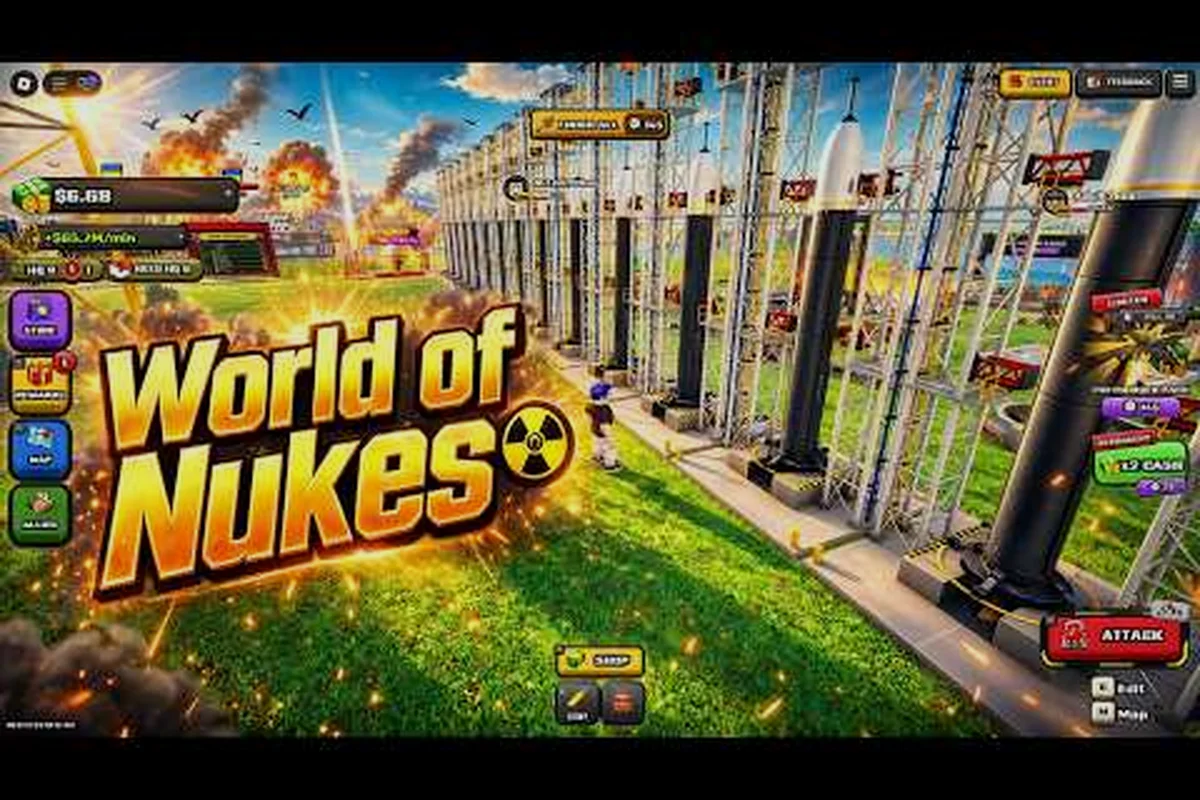
Becoming a superpower in World of Nukes is not about one big purchase — it is about stacking small compounding upgrades until your island out-produces everyone else. This guide breaks down the exact order of operations so your camp turns into a missile-armed nation without wasting a single dollar.
The core loop is simple to learn but easy to mismanage: expand land, raise income, then convert that income into military hardware. Players who rush missiles before their economy is stable usually stall out, while players who over-invest in land never build the Doomsday Device. The sweet spot sits in the middle, and this World of Nukes gameplay guide walks you through it step by step.
How World of Nukes Works at Its Core
World of Nukes is a Roblox island-nation tycoon from the Build. Defend. Nuke. group, and the official Roblox page describes the fantasy clearly: you start with a tiny camp and grow it into a superpower by expanding the island, deploying missiles, flying jets, commanding warships, and building anti-air defenses and shields. Understanding that arc is the first step toward mastering it.
The game runs on three interlocking systems that feed each other:
-
Land expansion — every new plot unlocks building slots, and more slots mean more income structures.
-
Income generation — passive earners fund everything else, so this is the engine of your whole run.
-
Military unlocks — missiles, jets, warships, anti-air, and shields convert money into power and defense.
If you understand how these three systems connect, you already understand how the game works. The trap most new players fall into is treating them as separate goals. They are not. Land exists to host income, income exists to fund military, and military exists to protect the income that lets you expand further.
The Compounding Rule
Every dollar you spend should either increase future income or protect existing income. A purchase that does neither is a luxury, and luxuries should wait until your economy is self-sustaining. This single rule separates fast-growing islands from stalled ones, and it applies from your first plot all the way to the Doomsday Device.
The Early Game: Camp to Stable Economy
Your first ten minutes decide your pace for the rest of the session. The goal here is not to look impressive — it is to build a money engine that runs while you are busy doing other things. Spend your opening cash on the cheapest income structures available and resist the urge to buy cosmetic or military items too early.
| Phase | Primary Goal | Typical Spend Priority | What to Avoid |
|---|---|---|---|
| Minute 0-5 | Unlock first income buildings | Cheapest earners, first land plot | Buying missiles or jets |
| Minute 5-15 | Stack passive income | Income upgrades, second plot | Over-expanding land you cannot fill |
| Minute 15-30 | Stabilize cash flow | Anti-air basics, income multipliers | Skipping defense entirely |
| Minute 30+ | Convert economy to military | Missiles, warships, shields | Ignoring your income base |
The table above is a rough tempo guide rather than a strict timer, because your actual pace depends on how efficiently you place buildings. The key insight is that income structures placed early pay for themselves many times over, while military purchases made early just sit there costing upkeep.
Placing Buildings for Maximum Return
Placement matters more than most players realize. Cluster your income buildings near the center of your island so future expansions radiate outward efficiently, and keep a clear lane for defensive structures. A build guide for your island layout covers the geometry in detail, but the short version is: economy in the middle, defense on the perimeter, military hardware on dedicated pads.
Unlocking Features in the Right Order
The question of how to unlock features efficiently comes down to cost-benefit. Some unlocks pay for themselves almost instantly, while others are long-term investments that only make sense once your income is high. Sorting them correctly is the difference between a fast run and a slow grind.
| Unlock | Relative Cost | Payoff Speed | Priority |
|---|---|---|---|
| Additional land plots | Low to medium | Immediate (more building slots) | High |
| Income multipliers | Medium | Fast (compounds every minute) | High |
| Basic anti-air | Medium | Situational (defense only) | Medium |
| First missile type | Medium to high | Slow (power, not income) | Medium |
| Jets and warships | High | Slow (prestige tools) | Low until stable |
| Shields | High | Defensive insurance | Low until threatened |
| Doomsday Device | Very high | Endgame milestone | Last |
Treat this table as a decision filter. When you have cash burning a hole in your pocket, scan down the priority column and buy the highest item you can afford. Land and income multipliers should almost always come before military hardware unless you are actively being attacked.
When Military Unlocks Become Worth It
Military unlocks stop being luxuries the moment your income base is stable enough to rebuild losses quickly. At that point, defense becomes an investment in protecting your compounding economy rather than a drain on it. If you are getting raided regularly, buying anti-air and shields early is correct even though the table lists them as medium priority — context beats any static ranking.
Turning Economy Into Firepower
Once your income runs on its own, the game shifts from building to projecting power. This is where the superpower fantasy actually kicks in, and it is also where most players make their biggest sequencing mistakes. The instinct is to buy the biggest missile available; the smarter move is to buy the missile that fits your current target set.
Missiles in World of Nukes vary in cost, blast radius, and unlock requirements, and the nuke launch guide breaks down each type in detail. For the purposes of becoming a superpower, the practical rule is to unlock one reliable mid-tier missile before chasing the biggest option, because a missile you can afford to fire repeatedly beats a single showpiece warhead.
Finding the Offense-Defense Split
A superpower is not just an attacker — it is a nation that can absorb a hit and keep functioning. Budget roughly two parts offense to one part defense once you reach the mid-game, adjusting toward defense whenever you notice repeated attacks. Shields and anti-air are cheap insurance compared to rebuilding a flattened income district, and the players who climb fastest are the ones who never let a single raid set them back ten minutes.
Mid-Game Progression: Scaling Without Stalling
The mid-game is where progression curves get steep. Unlock costs jump, and the gap between "affordable" and "worth it" widens. The fix is to stop buying everything and start buying multipliers — upgrades that increase the output of what you already own rather than adding new things to maintain.
| Strategy | Effect on Growth | Best Used When |
|---|---|---|
| Buy income multipliers | Multiplies existing earners | Cash flow feels slow |
| Expand land in bulk | Adds many slots at once | You have spare income buildings ready |
| Upgrade existing defenses | Cheaper than new structures | You are being probed by attackers |
| Save for a big unlock | Delayed but large payoff | You are near a milestone |
| Buy new military units | Adds capability, not income | Your economy is already stable |
The most common mid-game mistake is spreading purchases thin across every category. Concentrating spending on one system at a time produces faster visible progress than nibbling at everything, because each system has its own compounding curve and you want to ride one curve to its plateau before switching.
Reading Your Own Island
Before every purchase, ask what your island is actually short on. If cash accumulates faster than you can spend it, you need more building slots — buy land. If cash trickles in slowly, you need multipliers. If you keep losing structures, you need defense. This diagnostic habit is the single most useful skill in the game, and a late-game progression guide covers how the same logic scales up once the big milestones come into view.
Late-Game Milestones and the Doomsday Device
The official game page lists the Doomsday Device and various wonders as late-game milestones, and reaching them is the clearest signal that you have genuinely become a superpower. These are not impulse purchases — they require a mature economy, a defended island, and enough spare cash to absorb the cost without collapsing your income.
| Milestone | What It Requires | Why It Matters |
|---|---|---|
| Stable income base | Multiple upgraded earners | Funds everything else |
| Full defensive layer | Anti-air plus shields | Protects your investment |
| Missile arsenal | Several unlocked types | Projects power reliably |
| Wonders | Large cash reserves | Prestige and passive benefits |
| Doomsday Device | Everything above | The definitive superpower status |
Work down this list in order rather than jumping to the bottom. Players who save everything for the Doomsday Device while running a thin economy usually get raided into oblivion before they ever afford it, which is why the milestone table doubles as a checklist for readiness.
Wonders as Force Multipliers
Wonders are worth prioritizing over raw military spending once you can afford them, because their benefits compound across your entire island rather than adding a single unit. The wonders and nuke strategy guide explains which wonders pair best with an aggressive or defensive playstyle, and picking the right one for your situation is often worth more than two extra missiles.
Practical Habits That Speed Up Every Run
Beyond the big decisions, a handful of small habits separate fast-growing islands from slow ones. None of them are glamorous, but together they shave minutes off every stage of progression.
-
Check your income rate before every purchase so you know whether you are spending surplus or eating into your engine.
-
Rebuild immediately after a raid rather than waiting for a full cash reserve, because downtime is lost income.
-
Keep one lane clear for military structures so you never have to demolish income buildings to place hardware.
-
Bank a small reserve for defense so a surprise attack never forces you to sell structures.
-
Re-evaluate your build order every few minutes instead of following a fixed script, since the right purchase changes as your island grows.
These habits are especially valuable because World of Nukes rewards consistency over bursts. A player who logs in regularly, spends surplus efficiently, and never lets their economy idle will outpace a player who makes one huge purchase and then stalls.
Avoiding the Classic Traps
The three most common ways players stall are over-expanding land they cannot fill, buying military hardware before their economy can sustain it, and neglecting defense until a raid wipes out their income district. Each trap has the same root cause: spending on what looks impressive instead of what compounds. Check your last five purchases against that standard and you will usually spot the leak immediately.
Frequently Asked Questions
How long does it take to become a superpower in World of Nukes?
There is no fixed timer, but a focused run that prioritizes land and income multipliers before military hardware typically reaches the Doomsday Device milestone far faster than an unfocused one. Pace depends on how often you play and how efficiently you spend surplus cash, so treat any specific number as a rough estimate rather than a guarantee.
What should I unlock first in World of Nukes?
Start with the cheapest income structures and your first extra land plot. Income and building slots compound, so they pay for everything that follows. Military unlocks like missiles and jets should wait until your cash flow is stable enough to rebuild losses quickly, because early military spending just drains the economy you need to grow.
Does World of Nukes have a Doomsday Device?
Yes. The official Roblox page lists the Doomsday Device and various wonders as late-game milestones. Reaching it requires a mature economy, a defended island, and enough spare cash to absorb the cost without collapsing your income, so treat it as the final step of the progression rather than an early goal.
How do I stop getting raided in World of Nukes?
Build anti-air and shields once your income base is stable, and keep a small cash reserve specifically for defense repairs. Defense is cheaper than rebuilding a flattened income district, so buying protection early is almost always the correct call even when it delays your next offensive unlock by a few minutes.
Is World of Nukes pay-to-win?
Progression is driven by in-game income and smart spending order rather than purchases, based on how the tycoon loop is structured. Players who understand the compounding relationship between land, income, and military hardware consistently outgrow players who simply spend without a plan, which is why sequencing matters more than raw playtime.
Becoming a superpower in World of Nukes comes down to one principle: spend every dollar on something that compounds. Expand land to host income, upgrade income to fund military, and only then convert that economy into missiles, jets, and shields. Follow the priority tables in this guide, avoid the three classic traps, and the Doomsday Device stops being a distant dream and becomes the next item on your checklist.