
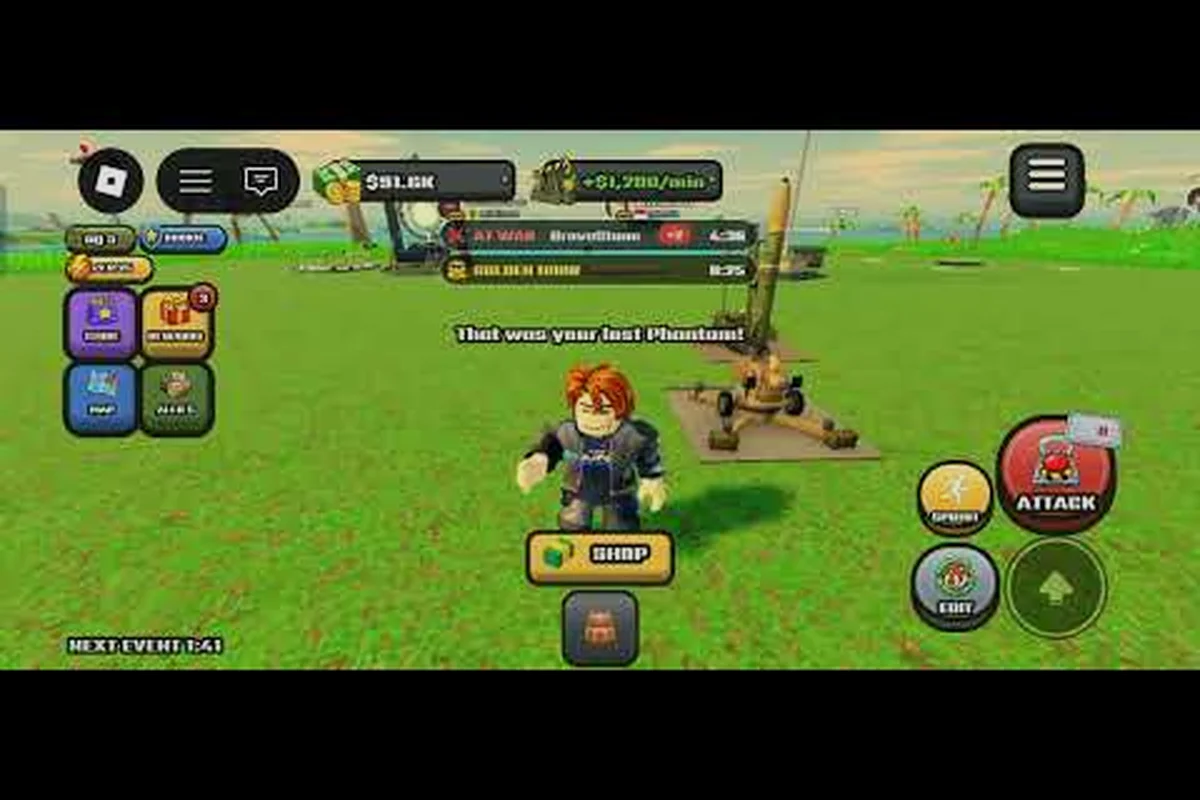
World of Nukes drops you on a tiny island camp with almost nothing, and the choices you make in the opening ten minutes decide whether you snowball into a superpower or stall out behind neighbors who already launched. This World of Nukes new player guide walks you from that first empty plot to your first missile launch, then into the mid game where real rivalries begin.
The game is small but fast: according to the official World of Nukes page, servers cap at 7 players, so every plot of land and every income building you place is contested space. That tight player count means early momentum matters more than raw grinding, and the tips below are built around that reality.
World of Nukes What to Do First: The Opening Ten Minutes
The single biggest mistake new players make is buying offense before income. Your camp starts with a minimal cash trickle, and a missile you cannot afford to reload is worse than no missile at all. Spend your first minutes on income buildings because they fund every later expansion, and treat offense as something that pays for itself once your economy is breathing.
Here is the priority order that community gameplay footage consistently shows working, including the Newbie to Roblox first-session capture where the first missile goes up around the ten-minute mark: income building placement, one reserved plot for expansion, a single focused upgrade, and only then your first launch. The reason the order matters is that each step compounds — a placed income building starts paying immediately, but a missile sitting in its silo generates nothing until you fire it, and every second it waits is cash your build queue could have been converting into more income.
-
Place income buildings first — they are the engine behind every upgrade and expansion you will ever buy.
-
Keep one plot open for your first expansion rather than filling every slot with cheap structures.
-
Upgrade your best income building before adding a second-tier one; concentrated income beats scattered income early.
-
Hold your first missile until your cash flow can absorb the reload cost without stalling your build queue.
That last point trips up a lot of people. Firing early feels great, but if the launch drains the cash you needed for a second income building, you have traded long-term growth for a ten-second dopamine hit. The World of Nukes early game guide principle is simple: economy first, fireworks second.
Reading Your Starting Camp Layout
Your starting camp is deliberately cramped, and that is a design choice rather than a punishment. With only a handful of buildable slots, you are forced to decide what earns its place. Income buildings that scale with upgrades deserve the prime slots; decorative or one-off structures can wait until you have expanded.
Walk the camp once before you build anything. Note where your income slots sit relative to your build queue and where your first expansion plot connects. Players who plan the layout before placing a single building waste far fewer rebuilds later, and rebuilds are the quiet killer of early momentum in a 7-player server where everyone else is already moving.
World of Nukes First Hour Guide: Building a Cash Engine
Your first hour is an economy sprint. The goal is not to look impressive on the map but to reach a cash flow that lets you buy upgrades without waiting. Every minute you spend watching a slow income tick is a minute a rival spends pulling ahead, so the World of Nukes first hour guide boils down to compounding your income as fast as your slots allow.
Use this early-game spending priority as your rule of thumb: pour every available dollar into the first income building the moment the match starts, then immediately buy its income building upgrade before adding anything new. The reason is mechanical, not stylistic — an upgrade multiplies your existing cash flow, while a fresh building only adds a second slow trickle, so the upgrade compounds faster per dollar spent. Only after that multiplier is locked in should you drop cash on a second income building and your first expansion plot, which unlocks the extra build slots your next income wave depends on. Skipping straight to a first missile before this chain is complete starves the engine that pays for every missile after it.
| Priority | Purchase | Why It Comes First | Rough Timing |
|---|---|---|---|
| 1 | First income building | Starts the cash trickle you will compound | Minute 0-2 |
| 2 | Income building upgrade | Multiplies existing flow instead of adding a new trickle | Minute 2-5 |
| 3 | Second income building | Adds a parallel stream once the first is upgraded | Minute 5-8 |
| 4 | First expansion plot | Unlocks more build slots for the next income wave | Minute 8-12 |
| 5 | First missile | Converts surplus cash into pressure on rivals | Minute 10-15 |
The timing column is a rough benchmark, not a strict clock. What matters is the order. If you find yourself at minute eight with three unupgraded income buildings and no expansion, you have spread too thin and should consolidate before buying anything new.
When Upgrades Stop Out-Earning New Land
There is a crossover point where another upgrade on the same building returns less than a fresh plot would. You hit it when your income building's next upgrade costs more than the expansion you have been eyeing. At that moment, expansion wins, because a new plot gives you room for a whole new income stream rather than a marginal bump on an existing one.
The land expansion and building system breakdown covers plot-by-plot placement in more detail, but the headline for new players is this: expand when upgrades get expensive, not when you run out of space. Waiting until you are boxed in means you have already wasted build slots on filler.
World of Nukes Early Game Guide: Your First Missile and First Rival
The first missile is a milestone, not a strategy. It signals that your economy can now support offense, and it changes how neighbors treat you. In a 7-player server, the player who launches first is rarely the one who wins, but the player who launches last is usually the one who got farmed. Aim to be somewhere in the middle: armed, but not overextended.
| First-launch tempo benchmark | Value / window | Why it matters for the first missile exchange |
|---|---|---|
| First missile launch timing (community footage) | ~10-minute mark of first session | Firing around this point means your income buildings are already online, so the silo cooldown overlaps production rather than pausing it |
| Retaliation window after your hit lands | 30–60 seconds | Your next income building must be queued before launch so this window is spent producing, not idling |
| Server cap (players per match) | 7 players | With 6 rivals in play, launching first rarely wins; launching last usually means you got farmed |
| Official page visits (as of Oct 31, 2026) | 2,663,507 visits | Large active pool means early lobbies fill fast — expect a full 7-player server and immediate rival pressure |
| Players online (as of Oct 31, 2026) | ~10,881 concurrent | High concurrency = short matchmaking waits, so your first exchange happens sooner than you think |
| Game like/dislike ratio | 5,248 likes vs 521 dislikes (~91% positive) | Signals a stable, actively played ruleset — the tempo check behaves consistently across sessions |
Here is how the first launch usually plays out and what to watch for: your missile leaves the silo, the target's alert timer starts ticking, and roughly 30–60 seconds later their counter-launch is already in the air — which is why the opening exchange is less a duel than a tempo check. If your build queue stalls while you're watching the impact animation, you've already lost the trade even if the hit landed clean. Treat the first launch as a probe: fire, keep your economy ticking underneath it, and read how the rival responds before committing to a second silo.
-
Check your cash buffer before firing. You want enough left over to keep your build queue moving.
-
Target the closest rival plot rather than a distant one; travel and targeting overhead eat into your tempo.
-
Expect retaliation. A first missile is a message, and the recipient will usually answer it.
-
Rebuild income immediately after the exchange. Offense pays for itself only if your economy keeps running underneath it.
Community reports from early sessions suggest the first missile exchange is where most new players either find their footing or fall behind permanently. The ones who recover fastest are the ones who never stopped building income during the fight. Concretely, that means queueing your next income building before you hit launch, so the silo cooldown and the 30–60 second retaliation window overlap with production instead of pausing it. Watch your cash buffer and build queue timers, not the impact animation — a stalled queue during the exchange costs you roughly the same as losing the trade outright, because your rival's economy keeps ticking while yours idles. Treat that first exchange as a tempo check you can pass simply by keeping production running underneath it.
Understanding the 7-Player Server Dynamic
Seven players is small enough that everyone knows everyone, and large enough that you cannot ignore the map. That creates a specific early-game rhythm: two or three players race ahead on economy, a couple play cautiously, and one or two over-invest in offense and burn out. Your job in the World of Nukes early game guide phase is to be in the racing group without drawing the whole server's attention.
The practical version of that is quiet compounding. Upgrade income, expand once, keep a missile in reserve, and avoid being the loudest player on the map until your economy can absorb a two-front exchange. Loud players get tested; quiet players get ignored until it is too late.
World of Nukes Mid Game Guide: Transitioning from Camp to Superpower
The mid game begins when your income no longer limits your decisions. At that point the question shifts from "what can I afford" to "what should I convert this cash into." This is where the World of Nukes mid game guide diverges sharply from the opening: you are no longer optimizing a trickle, you are allocating a budget.
The transition usually looks like this: your cash flow stops being the bottleneck and your plot count becomes the real constraint, so every new income building competes with a missile silo or defense slot for the same space. In practice, most players hit mid game the moment they can afford a second research line without stalling their economy — that is your signal to start converting surplus into either offense scaling (more missiles, faster reload) or economy scaling (another income stream to fund the next push). The trap is treating "comfortable" as "safe": a player who dumps everything into missiles here enters the superpower phase with a stockpile but no defensive depth, which is exactly the mistake the table below flags.
| Phase | Cash Flow | Main Decision | Common Mistake |
|---|---|---|---|
| Early camp | Tight, upgrade-gated | Which income building to buy next | Buying offense too soon |
| Expansion | Growing, plot-gated | Where to place the next income stream | Filling plots with filler |
| Mid game | Comfortable, choice-gated | Offense vs. further economy scaling | Over-investing in missiles |
| Superpower | Surplus, tempo-gated | Pressure rivals vs. defend holdings | Ignoring defense entirely |
Notice that the mistake column shifts as you progress. Early on, the danger is spending on the wrong thing; later, the danger is spending on too much of the right thing. A superpower with a maxed missile stockpile and no defensive depth is a target, not a threat.
Balancing Offense and Defense in the Mid Game
The mid-game balance most experienced players settle into is roughly two parts economy to one part offense, with defense folded into your expansion choices rather than treated as a separate budget. That ratio keeps your income scaling while ensuring you can answer a strike without halting construction.
If you want a more granular breakdown of which upgrades return the most value at this stage, the cash rewards and upgrade priority guide maps out the upgrade order that keeps your economy ahead of your rivals' offense. The short version: upgrade what you already own before buying new, and only buy new when the upgrade cost curve flattens.
Practical Tips That Separate Fast Starters from Slow Ones
Beyond the phase-by-phase plan, a handful of habits consistently show up in the sessions of players who reach superpower status quickly. None of them are secrets, but all of them are easy to skip when you are excited about launching missiles.
-
Rebuild before you retaliate. If a strike knocks out income, restoring that income comes before the counter-launch.
-
Keep one missile in reserve at all times. An empty silo invites pressure.
-
Expand on a schedule, not on impulse. One plot per income milestone keeps your layout coherent.
-
Watch rival income, not rival missiles. The player with the biggest economy is the real threat, even if someone else is firing more often.
-
Consolidate upgrades during quiet stretches. Peacetime is when compounding pays off most.
The new player checklist and progression roadmap turns these habits into a step-by-step sequence if you prefer a tick-box approach rather than a phase-based one. Either way, the underlying logic is the same: income compounds, missiles do not.
Using Free Rewards Without Spending Robux
The game's developer group, Build. Defend. Nuke., offers free rewards for liking the game and joining the group, according to the official Build. Defend. Nuke. group page. Those rewards are worth grabbing in your first session because they arrive before your economy can fund itself, which is exactly when a small boost matters most.
Beyond that, the free-to-play path is entirely viable. Nothing in the early or mid game requires Robux; the progression is gated by time and decision quality, not by spending. Players who treat the first hour as an economy puzzle rather than a combat demo reach superpower status on the same timeline as anyone else.
Frequently Asked Questions
What should I build first in World of Nukes?
Place an income building before anything else, then upgrade it before adding a second one. Income funds every later expansion and upgrade, so a strong early trickle compounds into a comfortable mid-game budget. Buying offense first stalls your economy and leaves you unable to reload.
How long until I can launch my first missile?
Community gameplay footage shows the first launch landing around the ten-minute mark in a clean session. You can fire earlier, but only if your cash flow survives the reload cost without halting construction. Firing before your economy can absorb it usually costs more than it gains.
Is World of Nukes pay-to-win?
No. The free-to-play path reaches superpower status on the same timeline as spending players, because progression is gated by decision quality and time rather than purchases. Free rewards from joining the developer group give a small early boost that helps new players get started.
How many players are in a World of Nukes server?
Servers cap at 7 players, which keeps the map contested but readable. Everyone can see everyone, so early momentum and quiet compounding matter more than raw aggression. Loud players get tested early; patient ones scale into the mid game unnoticed.
When should I expand my island instead of upgrading?
Expand when the next upgrade on your income building costs more than a new plot would. At that crossover, a fresh plot gives you a whole new income stream rather than a marginal bump, which is a better return on the same cash during the early and mid game.
Putting It All Together
The World of Nukes new player guide arc is short and sharp: build income, upgrade it, expand once, arm yourself, then convert a comfortable economy into map pressure. Players who follow that sequence reach superpower status within a session or two, while players who buy missiles first spend the same time rebuilding what they lost. Treat the first hour as an economy sprint, the mid game as a budgeting exercise, and the whole run as a compounding problem — because in a 7-player server, the player whose income never stops growing is the one still standing at the end.