
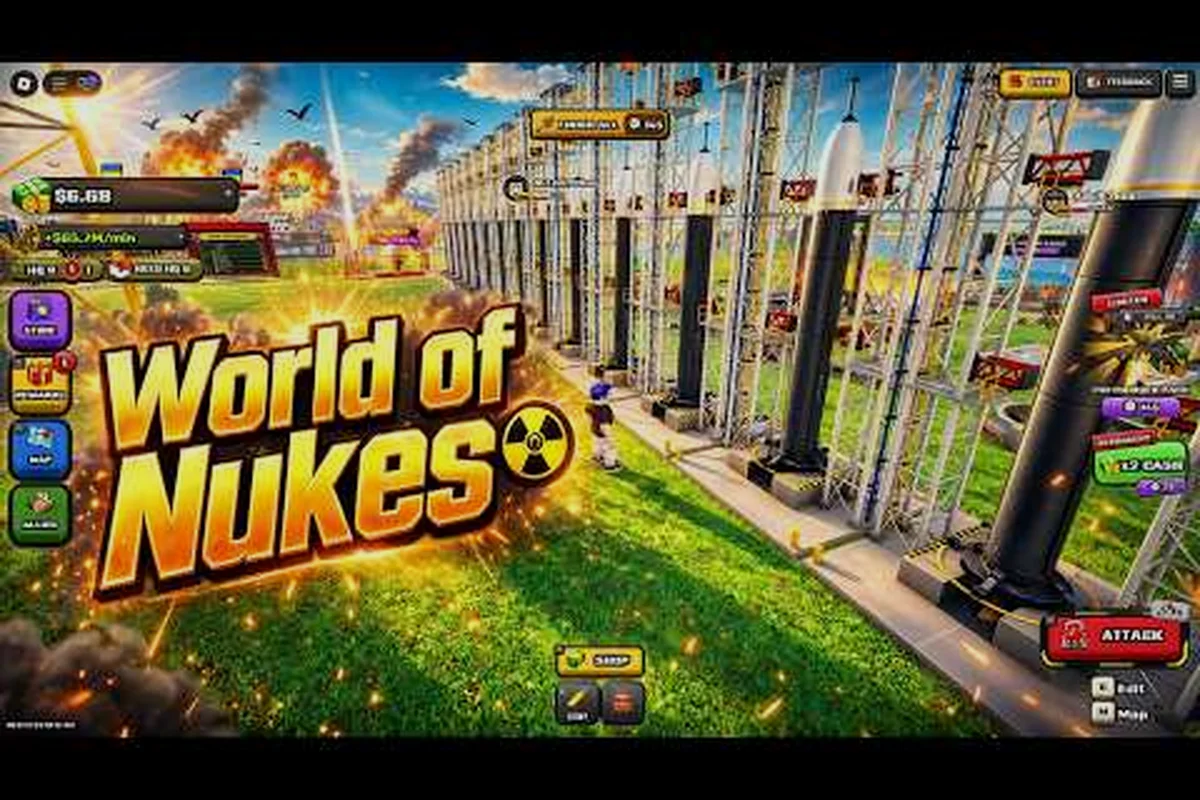
World of Nukes drops you on a tiny camp with almost nothing, and the whole point of the game is turning that speck of land into a missile-launching superpower. This beginner guide covers the opening moves that actually matter: income first, island second, weapons last. Get that order wrong and you stall out; get it right and your first missile launch is a short session away.
What World of Nukes Actually Asks of New Players
The official Roblox page describes World of Nukes as an island-nation tycoon from the Build. Defend. Nuke. group, and that three-word name is the entire loop in miniature. You build structures that generate cash, you defend the island from incoming threats, and eventually you nuke rivals. New players lose their first hour because they buy weapons before they buy income, then sit broke while enemy raids chew through their camp.
The core systems you will interact with in your first session break down like this, and the order matters more than any single purchase: income structures first, then island expansion to open buildable plots, then defense, then offense, and only much later the Wonders and Doomsday Device listed on the official page. Skipping ahead to missiles or jets before your cash flow stabilizes is the exact mistake that leaves new players broke and exposed, so treat each tier as a gate you clear before spending on the next.
-
Income structures — the buildings that pay you cash on a timer, and the only reason your economy exists
-
Island expansion — unlocking new land plots so you have room to place anything at all
-
Defense — anti-air and shields that stop raids from deleting your progress
-
Offense — missiles, jets, and warships that cost serious money and come later
-
Wonders and the Doomsday Device — late-game milestones listed on the official page, not something you touch on day one
That ordering is not a suggestion. It is the difference between a base that compounds and a base that resets every ten minutes. Community gameplay footage from the Newbie to Roblox channel shows the same pattern: a fresh camp, a fast income push, and the first missile launch landing around the ten-minute mark for a player who knows the sequence.
Why Income Comes Before Everything
Every structure in the game is gated behind cash, and cash only arrives through income buildings. If you spend your opening funds on a turret, you have a turret and no way to afford the next turret. If you spend it on income, you have a turret in two minutes plus everything after it. Treat your first purchases as investments rather than purchases, because that framing is what separates a fast start from a slow grind.
World of Nukes Getting Started: The First Ten Minutes
Your opening sequence should be nearly mechanical. Place income, wait for the first payout, place more income, and only then look at expansion. The table below is the rough priority order that experienced players follow when starting a fresh save.
| Priority | Action | Why It Comes Here |
|---|---|---|
| 1 | Place your first income structures | Nothing else is affordable without them |
| 2 | Upgrade existing income before adding new types | Upgrades usually pay back faster than new builds |
| 3 | Unlock the first expansion plot | You run out of build space quickly |
| 4 | Add basic defense near your income cluster | Protects the engine, not the empty edges |
| 5 | Save toward your first offensive option | Missiles are a mid-early goal, not a first buy |
The most common beginner mistake is treating the camp like a museum — placing one of everything to see what it does. Resist that. Every plot you fill with a decorative or premature building is a plot not generating income, and the game does not refund your curiosity.
Reading Your Cash Flow
Watch the number ticking upward rather than your total balance. If your income per tick is climbing, you are on track. If your balance grows but your per-tick number is flat, you have stopped investing and started hoarding — which feels safe and is actually the slowest way to play. A healthy early game has you spending most of your balance within seconds of earning it, because every dollar sitting idle is a dollar not compounding.
World of Nukes Tips and Tricks for Island Expansion
Island space is the real bottleneck in the early game, and the island building guide breaks down exactly how unlocking new land works. For a beginner, the practical version is simpler: expand as soon as you can afford it, and expand toward your income cluster rather than away from it. Scattered building placement wastes travel time and makes defense harder later.
A few expansion habits that pay off immediately: unlock plots in a single line toward your resource buildings rather than fanning out in every direction, since each new plot costs progressively more and a compact footprint lets one defensive cluster cover your entire income zone. Leave one-plot gaps between structures so you can slot in upgrades later without demolishing anything, and give every unlocked plot a job the moment it appears — an empty plot is wasted capacity that still counts toward your upkeep. Treat expansion as a directed investment, not a land grab.
-
Expand in one direction rather than ringing the camp, so your base stays compact and defensible
-
Keep income buildings adjacent to each other so you can protect them with a single defensive cluster
-
Leave gaps for future structures instead of packing everything shoulder to shoulder
-
Do not expand purely for aesthetics — every plot should have a job the moment you unlock it
The layout guide goes deeper on spacing, but the beginner rule is that compact beats sprawling every single time. A tight base is cheaper to defend and faster to upgrade, because your defensive cluster and your upgrade queue both operate within a short radius rather than stretching across half the island. Concretely, a compact footprint means a single turret placement can cover your entire income zone instead of forcing you to build two or three separate defensive clusters — and every duplicate turret you avoid is upkeep you don't pay. The same logic applies to upgrades: when your resource buildings sit adjacent, you cycle through upgrade timers back-to-back instead of waiting on travel between distant plots. Sprawling bases look impressive on day one and stall out by mid-game, when the upkeep from redundant defenses eats the income you needed for the next unlock.
When to Stop Expanding and Start Upgrading
There is a crossover point where new plots cost more than upgrading what you already own. You will feel it when a new plot takes several minutes of income to afford while an upgrade takes thirty seconds. At that moment, switch modes: stop buying land, start upgrading income buildings, and let your per-tick number climb until expansion is cheap again. Cycling between these two modes is the rhythm of the whole early game.
Building Defense Without Wasting Cash
Defense is where beginners either overspend or underspend, and both are fatal. Overspending means you build a fortress around a camp that generates nothing; underspending means a single raid wipes an hour of progress. The base defense guide covers shield and anti-air unlocks in detail, and the short version is that defense should scale with what you have worth protecting.
| Threat Level | Recommended Response | Approximate Timing |
|---|---|---|
| No raids yet | Skip defense entirely, bank the cash | First few minutes |
| Occasional light raids | One basic defensive structure near income | After first expansion |
| Repeated raids | Anti-air coverage over the income cluster | Once income is stable |
| Sustained pressure | Shields plus layered anti-air | Mid-game, after first missile |
The pattern is reactive, not preemptive. Build defense in response to a threat you have actually seen, because pre-building against imaginary raids is just another way to stall your economy. Once your income is stable enough that losing it would hurt, that is your signal to invest in protection.
The Cost of Losing Your Income Cluster
Losing a single income building is annoying. Losing the cluster is a soft reset. This is why defense placement matters more than defense quantity — a shield covering four income buildings is worth more than three turrets scattered across empty plots. Cluster your valuables, then cluster your protection around them.
World of Nukes How to Play Toward Your First Missile
The first missile is the milestone that changes how the game feels, because it is the moment you stop being a victim and start being a threat. Getting there requires a deliberate shift from pure economy to economy plus offense. The money-making guide covers the income side in depth; the missile side is about saving with intent.
Here is the practical sequence, and the order matters because each step protects the next one: a steady income from your money-making buildings funds the savings target, a hard cap on defense spending keeps that target reachable, and the missile purchase itself only happens once the target is met — buying early leaves you unable to afford the launcher's upkeep. Treat the list below as a checklist rather than suggestions; skipping the defense cap, for example, is the most common reason a fresh save stalls at twenty minutes with no missile and no savings progress.
-
Stabilize income first — you should be earning steadily without micromanaging
-
Cap your defense spending — enough to survive, not enough to bankrupt you
-
Set a savings target and stop buying anything else until you hit it
-
Buy the offensive option the moment you can afford it, not later
-
Use it immediately — an unused missile is just expensive decoration
Community footage puts a competent first missile launch around ten minutes into a fresh save, which is a reasonable benchmark. If you are twenty minutes in with no missile and no savings progress, your economy is too weak or your defense spending is too high.
Jets and Warships: Not Yet
The official page lists jets and warships alongside missiles, and new players often try to rush all three. Do not. Each is a separate expensive investment, and spreading your cash across three offensive systems means none of them is strong enough to matter. Pick missiles first, get comfortable with the launch flow, then branch out once your income can support a second system without stalling.
Common Beginner Mistakes That Cost Real Progress
Most early-game failures in World of Nukes trace back to a handful of repeatable errors, and nearly all of them share one root cause: spending before your income engine is running. A player who drops their starting cash on a weapons factory at minute one instead of a second income structure stalls their economy for several minutes, which then cascades into a weaker mid-game army and a defensive scramble. Recognizing these patterns in advance — buying income before weapons, expanding in a single direction rather than fanning out, and resisting the urge to over-build static defense — saves you a full reset and the ten-plus minutes it takes to rebuild from scratch.
| Mistake | What It Costs | The Fix |
|---|---|---|
| Buying weapons before income | Minutes of stalled economy | Income first, always |
| Expanding in every direction | Weak, indefensible base | Expand in one direction |
| Over-building defense early | Cash locked in idle structures | Defend reactively |
| Hoarding cash instead of investing | Flat income curve | Spend within seconds of earning |
| Rushing all offense types at once | Three weak systems | Master one, then branch |
The through-line is impatience. World of Nukes rewards players who let their economy compound for a few minutes before reaching for the fun toys, and punishes players who reach first. The beginner-focused guide covers additional pitfalls if you want a second pass on the fundamentals.
Recovering From a Bad Start
If your base is already a mess of scattered buildings and no income, you do not necessarily need to reset. Sell or stop upgrading the non-income structures, funnel everything into income buildings, and rebuild the cluster compactly. Recovery takes longer than a clean start but is usually faster than re-learning the opening from scratch.
Frequently Asked Questions
What should I build first in World of Nukes?
Place income structures before anything else, because every other building in the game is gated behind cash. A single early turret leaves you unable to afford the next purchase, while early income compounds into everything you need. Upgrade existing income before adding new building types for the fastest early curve.
How long does it take to launch a first missile?
Community gameplay footage shows an experienced player launching a first missile roughly ten minutes into a fresh save. New players typically take longer because of trial and error. If you are well past twenty minutes with no missile and no savings progress, your economy or defense spending needs adjusting.
Do I need defense right away in World of Nukes?
No. Skip defense entirely for the first few minutes and bank that cash into income instead. Build defensive structures reactively, once you have actually seen a raid or once your income cluster is valuable enough that losing it would hurt. Pre-building against imaginary threats just stalls your economy.
Is it better to expand my island or upgrade buildings?
Alternate between the two based on cost. Expand while new plots are cheap, then switch to upgrading income buildings once a new plot costs several minutes of income. Cycling between expansion and upgrades keeps your per-tick earnings climbing without wasting cash on overpriced land.
Can I rush jets and warships as a beginner?
Not effectively. Each offensive system is a separate expensive investment, and splitting cash across missiles, jets, and warships leaves all three too weak to matter. Focus on missiles first, learn the launch flow, and only branch into other systems once your income supports it comfortably.
The whole beginner curve in World of Nukes comes down to one habit: let your economy run ahead of your ambitions. Build income, expand compactly, defend only what is worth defending, and save with a clear target in mind. Do that and your first missile stops being a distant goal and becomes the natural next step on the road to superpower status.