
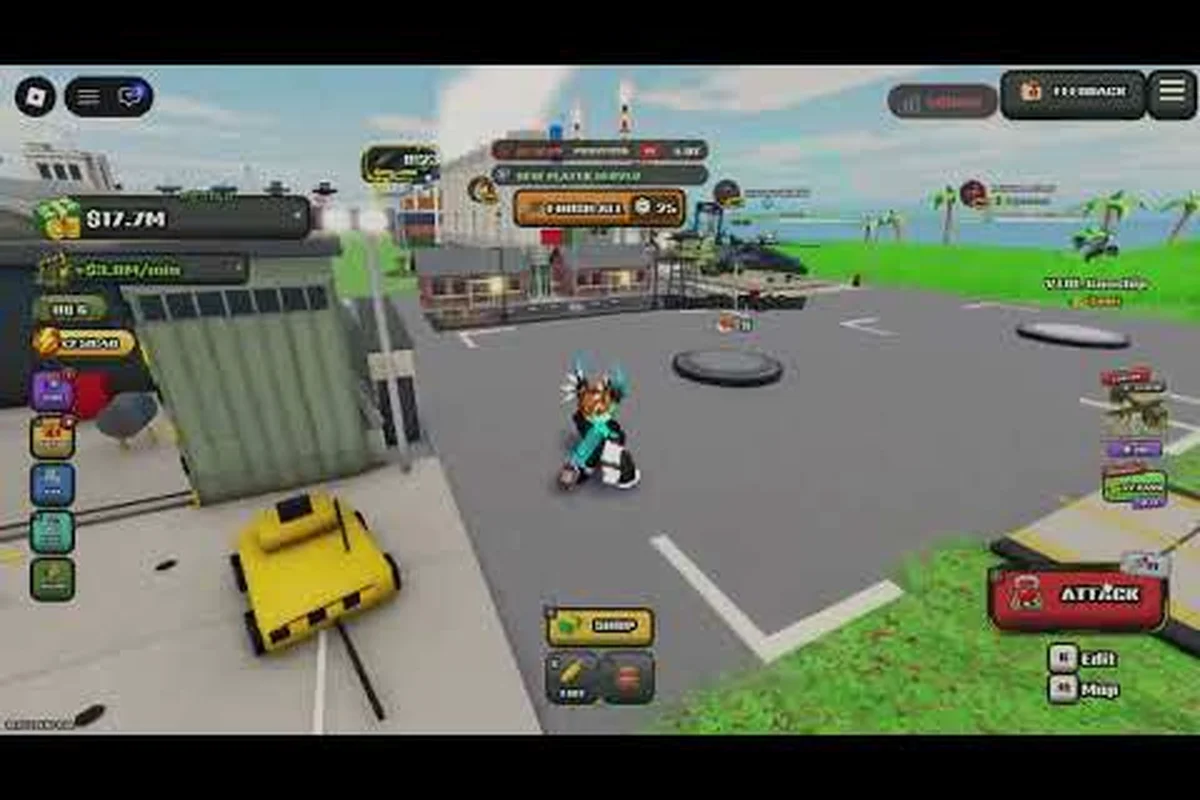
The world of nukes best build order is not a mystery once you understand that every missile you fire is paid for by an income building you placed ten minutes earlier. This guide breaks down the exact sequence that turns a tiny tropical camp into a superpower island, including which unlocks to chase first and when expanding land actually pays off.
For the full list of available units, their costs, and current balance values, refer to the official World of Nukes Roblox game page, which is the most reliable place to confirm build-order timings before committing to a strategy.
Why Income Comes Before Firepower in the World of Nukes Best Build Order
The single biggest mistake new players make is rushing the missile launcher. It feels productive because something explodes, but the official Roblox game page makes the intended progression clear: you start from a small camp, grow through island expansion and building upgrades, and reach superpower status only when your economy can sustain it. Income structures fund every later expansion, while offense pays for itself much later in the run.
That is the core logic behind an income-first build order. If you spend your opening cash on defense, you stall. If you spend it on income, you snowball. Community gameplay footage from Newbie to Roblox shows the first missile launch landing at roughly the ten-minute mark on a clean income-first opening, which is a useful benchmark for whether your own run is on pace.
Here is how the two opening philosophies compare in practice: an income-first opener typically lands 3-4 income buildings before the five-minute mark, which pushes the first missile launch to roughly 10 minutes and keeps 15-minute cash flow high and compounding toward a superpower island. A defense-first opener spends those same early resources on 1-2 turrets plus a single income structure, delaying the first missile to about 18 minutes and flattening cash flow into a mid-tier ceiling. The gap isn't cosmetic — it's the difference between a growth rate that accelerates and one that stays capped.
| Build Order | First 5 Minutes | First Missile | 15-Minute Cash Flow | Long-Term Ceiling |
|---|---|---|---|---|
| Income-first | 3-4 income buildings | ~10 minutes | High, compounding | Superpower island |
| Defense-first | 1-2 turrets, 1 income | ~18 minutes | Flat, capped | Mid-tier base |
| Offense-rush | 1 launcher, weak economy | ~6 minutes | Very low | Stalls hard |
| Balanced split | 2 income, 1 turret | ~13 minutes | Moderate | Slow but safe |
The offense-rush column is tempting because it produces the earliest explosion, but it collapses the moment your income can't replace spent resources. Defense-first is the safer trap — you survive longer but never scale. Income-first wins because it is the only path where your growth rate increases over time rather than staying flat.
The Compounding Effect of Early Income
Every income building you place in the first few minutes generates resources for the entire rest of the session. A structure placed at minute two has eight more minutes of output than one placed at minute ten. That gap is why the world of nukes best build order front-loads economy so aggressively — you are not just buying income, you are buying time.
Players who rebuild after each update often notice that building sizes shift, which can break a layout that was tight before. Keep your income cluster compact but leave a one-tile buffer so a resize doesn't force a full teardown. The island building guide covers how to adapt a layout when footprint changes hit.
The Opening Sequence: First Ten Unlocks in Order
Your first ten unlocks decide whether the run feels smooth or grindy. The order below assumes a fresh island with limited land and no premium boosts, and it mirrors what community players report as the most consistent opening in 2026.
| Priority | Unlock | Why It Comes Here | Approx. Cost Tier |
|---|---|---|---|
| 1 | Basic income structure | Funds everything else | Low |
| 2 | Second income structure | Doubles early cash flow | Low |
| 3 | Land expansion (first) | Room for income cluster | Low |
| 4 | Income upgrade I | Cheapest output multiplier | Low |
| 5 | Storage / capacity | Prevents idle overflow | Medium |
| 6 | Third income structure | Keeps scaling | Medium |
| 7 | Basic turret | Minimal survival insurance | Medium |
| 8 | Land expansion (second) | Space for defense ring | Medium |
| 9 | Missile launcher | First real offense | Medium |
| 10 | Shield / anti-air | Protects the core | High |
Notice that the missile launcher sits at slot nine, not slot three. That placement is deliberate. By the time you unlock it, your economy can absorb the cost of firing without stalling your next upgrade. If you unlock the launcher before slot six, you will almost always find yourself unable to afford the follow-up structures that make the launcher useful.
When to Break the Order
There are two legitimate reasons to deviate. First, if your server has aggressive neighbors, move the basic turret up to slot five — dying with a perfect economy is still dying. Second, if an update changes building sizes, prioritize the land expansion earlier so you have room to rearrange without demolishing income. The build guide walks through how to unlock new land efficiently when space gets tight.
Planning Your Island Layout Around the Build Order
World of Nukes island planning is where most players lose their advantage. A perfect unlock order on a badly organized island still underperforms, because travel time between structures and rebuild costs eat your gains. The community island-building footage from Zainrail demonstrates the standard fix: keep income structures close together to reduce travel time, and reserve a clear ring around the core for anti-air and shields.
The layout principle is simple — three zones, expanding outward — and it maps directly onto the unlock order, so each new building drops into a slot that already exists instead of forcing a rebuild. Think of it as a 3:1 ratio: for every three income structures you place in the core, keep one tile of the defense ring clear, which is roughly what the first shield and anti-air unlock will demand. Zainrail's footage shows the payoff in practice — players who pre-reserve that perimeter hit their first superpower footprint without demolishing a single income building, while players who fill the ring early lose roughly two structures' worth of rebuild time right when the mid-game unlock window opens.
-
Core zone: your most valuable income buildings and storage, packed tight in the center.
-
Defense ring: a clear perimeter reserved for turrets, anti-air, and shields, kept empty until you need it.
-
Expansion buffer: the outer edge where new land purchases attach, always left partially open.
Keeping the defense ring empty early feels wasteful, but it saves you from the classic mid-game disaster where you must demolish two income buildings to fit a shield. The base layout reference shows how that ring scales from a camp to a full superpower footprint.
Spacing Rules That Survive Updates
Buildings get resized. Layouts that were pixel-perfect break. The rule that survives every patch is to leave a one-tile gap between income structures rather than butting them directly against each other. You lose a little density but gain the ability to slot in upgrades and new building types without a full rebuild.
Timing Your Land Expansion Correctly
Land is the most misjudged purchase in the game. Expand too early and you spend resources on empty ground; expand too late and your income cluster is capped by space. The reliable trigger is simple: expand when your current land is 80% occupied by income and storage, not when you run out entirely.
| Island Stage | Land Purchases | Income Buildings | Typical Trigger |
|---|---|---|---|
| Camp | 0-1 | 2-3 | Starting layout fills up |
| Outpost | 2-3 | 4-6 | First upgrade tier complete |
| Fortified base | 4-5 | 7-9 | Defense ring needs space |
| Superpower island | 6+ | 10+ | Economy self-sustaining |
The jump from outpost to fortified base is where most runs stall, because players expand land without filling it. Buying land you don't immediately use is a resource leak. Each expansion should be followed within a minute or two by a structure placed on it.
Reading Your Own Pace
If you find yourself waiting on resources with nothing to build, your economy is underbuilt — go back and add income before buying more land. If you have resources but no space, you expanded too slowly. The world of nukes island gameplay loop rewards players who keep those two pressures balanced rather than maxing either one.
Mid-Game Transitions: From Economy to Superpower
Somewhere around the fortified base stage, the build order flips. Income stops being the bottleneck and defense plus offense capacity becomes the constraint. This is the point where the world of nukes best build order shifts from "more income" to "protect and project."
The transition checklist looks like this: verify your income can fund a full missile salvo without dropping below your next upgrade cost, then fill the defense ring with anti-air coverage before adding any more offense. Upgrade existing income structures instead of placing new ones — upgrades are typically cheaper per unit of output — and keep one land expansion in reserve so you can rearrange under pressure. Treat these four checks as a gating sequence: skipping the anti-air layer is the single most common reason fortified bases collapse once opponents field air units.
-
Confirm your income can fund a full missile salvo without dropping below your next upgrade cost.
-
Fill the defense ring with at least anti-air coverage before adding more offense.
-
Upgrade existing income structures rather than adding new ones — upgrades are usually cheaper per unit of output.
-
Keep one land expansion in reserve for emergency rearrangement.
Players who skip the defense ring during this phase often report losing progress rapidly once opponents field air units. The best layout breakdown explains how to layer anti-air and shields so a single breach doesn't expose your income cluster.
Balancing Offense and Survival
A superpower island needs both. The practical split most experienced players settle on is roughly 60% economy, 25% defense, 15% offense during the mid-game, shifting toward 45/30/25 once the island is fully built. That ratio keeps your income dominant while ensuring you can absorb a hit and retaliate.
The Four Build Order Errors That End Runs
Most failed runs in world of nukes trace back to one of four errors — rushing the launcher before income structures, over-expanding land, ignoring storage, or skipping a defense ring — and each has a clean fix you can apply mid-run without demolishing anything. The pattern is consistent: every mistake is really a build order sequencing problem, where a structure gets placed before the income or capacity exists to support it. Watch for the early symptoms, like capped resources or unaffordable follow-up upgrades, because catching them at the first unlock slot costs far less than rebuilding after a collapse.
| Mistake | Symptom | Fix |
|---|---|---|
| Rushing the launcher | Can't afford follow-up upgrades | Demolish nothing; pause offense, add income |
| Over-expanding land | Empty tiles everywhere | Fill current land before buying more |
| Ignoring storage | Resources cap and idle | Add capacity at unlock slot five |
| No defense ring | Sudden collapse to air units | Clear perimeter, add anti-air early |
The over-expansion mistake is the most common in 2026 because land feels cheap early. It isn't — every unused tile is a structure you didn't build. The fix is mechanical: never buy land unless you have a structure ready to place on it within the next two minutes.
Recovering a Stalled Run
If your run has already stalled, don't restart immediately. Demolish your least efficient offense structure, redirect that budget into income, and wait two full income cycles before re-engaging. Most stalled islands recover within five minutes of disciplined economy focus, which is far faster than a fresh start.
Frequently Asked Questions
What is the best first building in World of Nukes?
The basic income structure is always the correct first purchase because it funds every subsequent unlock. Placing two income buildings before any defense gives you the fastest path to your first land expansion, and community footage shows this opening reaching the first missile launch around the ten-minute mark.
Should I expand my island before or after upgrading income?
Upgrade income first, then expand when your current land is about 80% full. Buying land early leaves you with empty tiles that generate nothing, while upgrading first increases output on ground you already own. Expansion should follow a structure you're ready to place.
How many income buildings do I need before building a missile launcher?
Aim for at least three income structures plus one income upgrade before unlocking the launcher. That baseline lets you fire without dropping below your next upgrade cost, which is the real test of whether your economy can support offense according to community testing.
Does the build order change after updates?
Yes, building resizes can force layout adjustments, so keep a one-tile buffer between income structures and leave your defense ring partially open — a gap wide enough for a missile launcher footprint but narrow enough to funnel attackers. The unlock priority itself stays stable, but spacing and placement need periodic review after each patch: re-check your land expansion ratio and confirm no income building sits flush against a wall that a resize could trap. Treat the buffer as part of the build order, not an afterthought.
How long does it take to reach a superpower island?
On a clean income-first run, most players reach fortified base status within the first session and push toward superpower status once their economy self-sustains. The exact timing depends on server activity and how aggressively you expand land, so treat any single number as a rough benchmark rather than a rule.
Final Thoughts on Building a Superpower Island
The world of nukes best build order comes down to one principle repeated at every stage: let income pay for the next step. Front-load economy, expand land only when you're ready to fill it, reserve a defense ring from the very first minute, and shift toward protection once your economy can fund a full salvo. Players who follow that sequence consistently reach superpower status faster than those who chase the first explosion — and they keep it once they get there.