
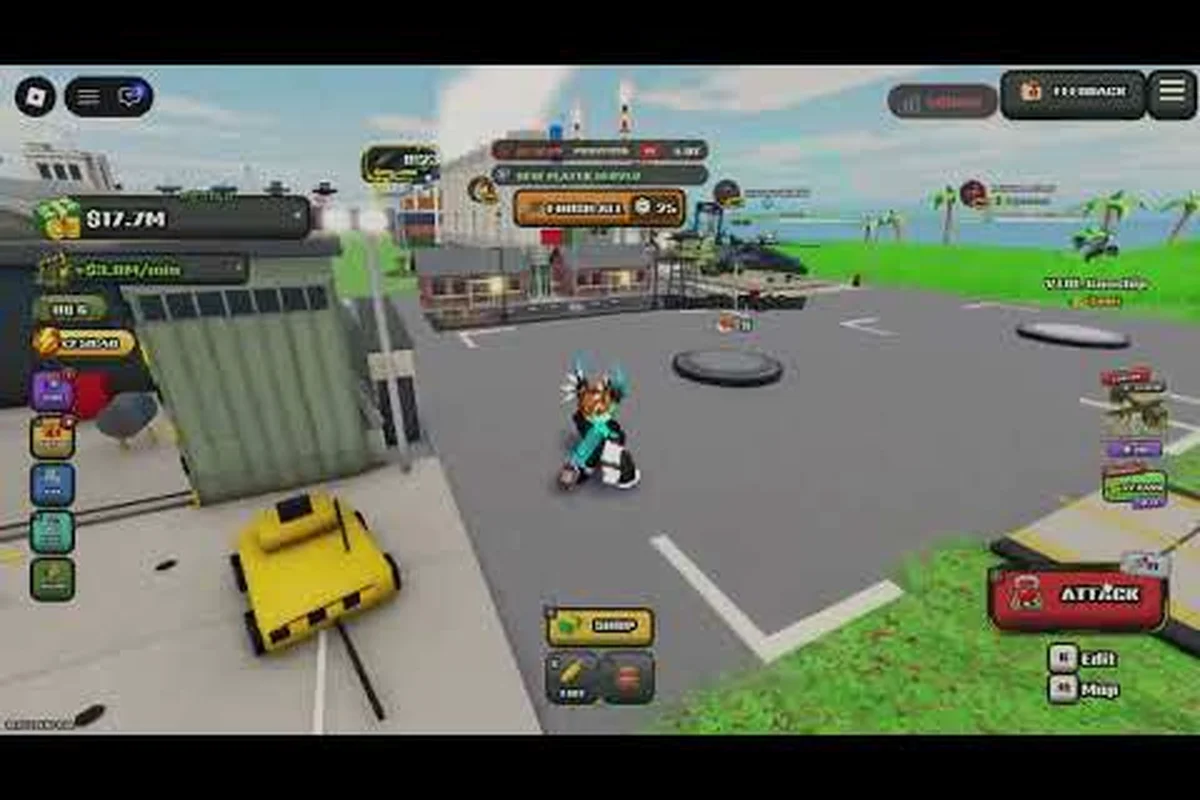
Cash in World of Nukes is not a reward you chase — it is a loop you build, and the world of nukes income sources you unlock in your first hour decide how fast everything else snowballs. Get the loop wrong and you will be stuck rebuying military units you cannot afford; get it right and the numbers start working while you sleep.
This breakdown maps every confirmed cash faucet — from passive income buildings and territory capture bonuses to the resource-management loop that keeps your treasury positive — shows how to spend cash without stalling your income, and ranks the investments that actually compound in the 2026 economy. The core idea is simple: income buildings first, everything else second. Skipping that order is the single most common reason players plateau mid-game, because a stalled faucet means every military rebuy eats into the capital you needed for the next compounding upgrade.
Why Income Sources Beat One-Time Payouts in World of Nukes
The single most common mistake new players make is treating cash like a score to spend immediately on units and defenses. Cash in this game behaves more like a production stat than a wallet balance — the buildings that generate it are the real asset, and every purchase that does not raise your per-second income is a purchase that slows your next upgrade.
According to the official World of Nukes page on Roblox, cash arrives from four broad channels: income buildings, codes, events, and the group reward. That is the whole map, and it is worth memorizing because it tells you where to look when your income plateaus.
-
Income buildings — passive generators that tick cash continuously and scale with upgrades
-
Codes — one-time injections, with KABOOM confirmed at 100K Cash
-
Events — limited-time windows that spike earning rates
-
Group reward — a free bonus tied to the developer group and liking the game
The reason passive income dominates is compounding. A one-time 100K from a code feels enormous at minute five and irrelevant at hour five, while a modest income upgrade purchased early keeps paying for the rest of the session. Players who internalize this early tend to pull ahead of their lobby without ever grinding.
The Multiplier Math Behind Every Building
Think of each income building as a multiplier on your time. If a building produces a small amount per second, doubling its output doubles everything downstream — your ability to buy the next building, your ability to absorb a raid, your ability to recover after a nuke lands on your base.
That is why the world of nukes best investments are almost always boring ones. The flashy purchases (heavy units, big defenses) protect what you have, but they do not grow the pool. The unglamorous purchases (income tiers, cheap upgrades) grow the pool, and a bigger pool makes every later decision cheaper in relative terms.
Every Confirmed World of Nukes Income Source
Here is the practical list, ordered by how reliably each source contributes to a session. Treat the reliability column as your planning tool: the top rows are things you can count on every run, the bottom rows are bonuses you should never build a strategy around.
| Source | Type | Reliability | Notes |
|---|---|---|---|
| Income buildings | Passive, continuous | Very high | Scales with upgrades; the backbone of any run |
| Group reward | One-time free bonus | High | Requires joining the developer group and liking the game |
| KABOOM code | One-time injection | High | Confirmed at 100K Cash as of 2026-10-31 |
| Events | Timed spike | Medium | Availability varies; check before planning a session |
| Other codes | One-time injection | Medium | Only KABOOM is code-confirmed for cash right now |
The group reward deserves special attention because it costs nothing but two clicks. The game is developed by the Build. Defend. Nuke. Roblox group, which the official group page lists at roughly 51,279 members and community Tier 3 as of October 31, 2026. The group owner holds a verified badge, and the official description states that liking the game and joining the group grants free rewards.
In practice, that means your very first action in a new session should be confirming you are in the group and that you have liked the game. Both checks are binary and take seconds, yet the payoff is a one-time free bonus that lands in the same Cash pool your income buildings feed — so claiming it early compounds with your first building upgrades instead of arriving after your economy has already scaled past it. Skipping it leaves free cash on the table for no reason, and because the group reward is flagged High reliability in the table above, it belongs in your opening routine alongside the KABOOM code, not in the optional bottom rows.
Codes: What Is Actually Confirmed
Code lists floating around community spaces are noisy, and many entries are expired, region-locked, or simply invented. Based on community reporting as of late 2026, KABOOM is the only code-confirmed cash injection, worth 100K Cash. Treat every other code as unverified until you personally redeem it and see the balance move.
Redeeming is straightforward and takes seconds, so the real discipline is not chasing codes but remembering to check them before you start upgrading. A 100K injection early in a run can fund an entire income tier you would otherwise wait several minutes for.
How to Spend Cash Without Killing Your Income Curve
Knowing the sources is half the job; the other half is the world of nukes how to spend cash question, and the answer is more rigid than most players expect. The rule that works: never let your cash balance sit idle above the cost of your next income upgrade.
That single habit prevents the classic trap of hoarding for a big military purchase while your production stat stays flat. A flat production stat means every minute you wait is a minute of lost compounding, and the loss is invisible because your balance still looks healthy.
| Spending Priority | Purchase | Why It Comes First |
|---|---|---|
| 1 | Next income building or income tier | Raises the rate everything else depends on |
| 2 | Cheap efficiency upgrades | Low cost, permanent rate improvement |
| 3 | Defensive coverage | Protects the loop from raids and nukes |
| 4 | Military units | Offensive pressure once the loop is stable |
| 5 | Cosmetic or luxury buys | Never before the loop is self-sustaining |
Notice that military units sit at priority four, not one. This is counterintuitive for players coming from combat-focused games, but in an economy where income compounds, offense purchased too early is offense you cannot replace after a bad fight.
Checking Your Cash Rate Before You Spend
Before every purchase, glance at two numbers: your current cash per second and the cost of your next income upgrade. If the upgrade pays for itself in a reasonable window, buy it. If it does not, buy something cheaper that still raises the rate, or wait and let the balance climb toward it.
This is the entire discipline of world of nukes resource management compressed into one habit: never spend a dollar that lowers your cash-per-second growth curve. Players who check the rate before spending rarely end up broke, because they never convert their production capacity into units they cannot sustain. Concretely, if your income sits at 1,200 cash/sec and a nuke silo costs 40,000, that purchase eats roughly 33 seconds of pure production — affordable only if your next income upgrade is already queued behind it. Skip the upgrade first and you stall your compounding; buy the rate-booster first and every later nuke, factory, and research unlock arrives cheaper in real time. That ordering, not raw cash totals, is what separates stable economies from boom-and-bust ones.
Ranking the Best Investments in the 2026 Economy
The world of nukes economy 2026 rewards a specific shape of play: fast early income, moderate defense, delayed offense. Below is a ranking of investment categories by how much value they return per unit of cash spent, based on the mechanics described on the official game page and consistent community reporting.
| Rank | Investment | Return Profile | Best Timing |
|---|---|---|---|
| S | Income building upgrades | Highest long-term return; compounds every second | Immediately, repeatedly |
| A | Group reward and code redemption | Free or near-free value | Session start, every session |
| B | Cheap defensive upgrades | Protects existing income from loss | After first income tier |
| C | Event participation | Situational spike, availability-dependent | When an event is live |
| D | Heavy military units | Slow return, high replacement cost | Only after income stabilizes |
The gap between S and D is not small. An income upgrade purchased in the first two minutes of a run can outproduce an entire military push over the length of a session, because the military push has to be replaced after losses while the income upgrade never dies.
If you want a deeper walkthrough of the specific upgrade sequence, the upgrade order breakdown covers which tiers to buy in which sequence. The short version: buy the cheapest rate increase available at all times, and only step up to expensive tiers once the cheap ones are exhausted.
Where Events Fit
Events are the wildcard in the world of nukes cash farming guide. When one is live, earning rates can spike enough to justify temporarily pausing your normal upgrade rhythm and pushing harder on whatever the event rewards. When no event is live, do not wait around for one — the passive loop should carry you.
Community footage of income lists, such as the community income-list video, shows players running the same core loop with minor variations, which suggests the fundamentals are stable rather than dependent on any single trick.
A Practical Cash Farming Routine for New Sessions
Here is a repeatable opening routine that front-loads the world of nukes income sources and gets your production stat moving within the first few minutes of any session. The logic is that every dollar sitting idle in your balance is a dollar not compounding, so the sequence is built around converting cash into rate as fast as possible: claim the free group reward, redeem KABOOM for its 100K Cash injection, then immediately dump that injection into the cheapest income upgrade available rather than holding it. From there you repeat the buy-cheapest-tier cycle until the next tier comes into reach, which is where the early-game curve actually bends — a single large tier purchase stalls your rate for minutes, while three small ones stack.
-
Confirm the group reward — join the Build. Defend. Nuke. group and like the game if you have not already, then claim the free reward.
-
Redeem KABOOM — enter the code for 100K Cash before you spend anything, so the injection funds your first income tier rather than padding a balance you already spent.
-
Buy the cheapest income upgrade — do not save toward a big tier; take the small rate increase now and let it work while you do everything else.
-
Repeat step three until the next tier is affordable — this is the whole early game, and it is intentionally repetitive because repetition is what compounds.
-
Add one defensive layer — once income is ticking, buy enough defense to survive a raid. Not more than enough; the goal is protecting the loop, not building a fortress.
-
Check for live events — if one is running, lean into it; if not, keep cycling income upgrades.
That routine is deliberately unglamorous, and that is the point. The players who climb fastest are not doing anything secret — they are simply not wasting cash on purchases that do not raise the rate. Concretely, that means skipping cosmetic skins, one-off boosts, and mid-tier defense purchases until your income-per-second has cleared the next upgrade threshold; a single defensive tower bought too early can cost you an entire upgrade tier's worth of compounding. The discipline matters most in the first ten minutes, when every 100K Cash from KABOOM is worth roughly three times what it will be worth later, simply because it arrives while your rate is still low. Treat your balance as a staging area, not a savings account: if cash is sitting untouched for more than a few seconds, you are already behind the curve.
If your balance keeps hitting a ceiling, the cash limit explainer covers what happens at the cap and how to plan around it, which matters once your income outpaces your spending options. The trap is subtle: a capped balance silently wastes every second of production that would have overflowed, so the routine above only compounds while your rate stays below the limit. Once your income-per-second climbs high enough that a single KABOOM injection or group reward pushes you near the cap, shift the priority from buying the cheapest tier to buying the largest affordable tier — that converts surplus balance into permanent rate before the overflow is lost. Check the cap threshold before each session, and if you are within one upgrade of it, buy that upgrade first rather than banking toward a bigger one.
Common Spending Mistakes to Avoid
-
Hoarding for a big unit while income stays flat — the single most expensive habit in the game
-
Buying defense before income — you end up protecting a small pool instead of growing a large one
-
Ignoring the group reward — free cash left unclaimed every session
-
Redeeming codes after spending — the injection loses its compounding head start
-
Skipping cheap upgrades because they look insignificant — they are the highest-return purchases available
Each of these mistakes has the same root cause: treating cash as a thing to spend rather than a rate to grow. Fix the mindset and the specific decisions follow naturally. Concretely, that means before any purchase, ask what it does to your per-second income — a nuke upgrade that lifts passive generation by even 5% compounds every session you keep playing, while a one-off big-unit purchase stops paying the moment it's bought. This is why the cheapest upgrades in the shop so often beat the flashiest ones: their return-on-cost is higher, so the cash you sink into them recycles back into your income stream faster. Once you start evaluating every decision by its effect on your earning rate instead of its sticker price, the five traps above stop looking like separate mistakes and start looking like one habit you've already broken.
Balancing Income and Defense as the Session Progresses
Mid-session, the question shifts from "what do I buy" to "how much defense can I afford without stalling income." The answer depends on how contested your lobby is, but a useful default is to keep defense spending to roughly the cost of one income tier at a time, then return to income.
This keeps your production growing while ensuring a single raid cannot wipe the progress you have built. Players who over-invest in defense early often find themselves safe but poor, unable to replace losses or push for objectives because their rate never developed.
The money-making methods guide goes deeper on mid-game transitions, including how to read whether your lobby is aggressive enough to justify extra defense spending. The principle stays the same at every stage: income is the engine, defense is the insurance, and insurance should never cost more than the engine is worth.
When to Stop Upgrading Income
There is a point in longer sessions where the next income tier costs so much that the payback window stretches beyond the remaining session. At that point, redirect cash into defense and units, because further income investment will not have time to compound.
Recognizing that point is a skill in itself. A rough test: if the next income upgrade would take longer to pay for itself than you expect the session to last, stop buying income and start converting your rate into board presence.
Frequently Asked Questions
What are the main income sources in World of Nukes?
Cash comes from four confirmed channels: passive income buildings, codes such as KABOOM, limited-time events, and the free group reward for joining the developer group and liking the game. Income buildings are the only continuous source, which is why they anchor every serious strategy.
Is KABOOM the only working cash code?
Yes, KABOOM is currently the only code-confirmed cash injection in World of Nukes, granting 100K Cash as of October 31, 2026. Don't rely on codes for sustained income, though—income buildings, events, and the Build. Defend. Nuke. group reward are your repeatable sources. Redeem KABOOM once, then invest that 100K into income upgrades first.
Should I buy military units or income upgrades first?
Income upgrades first, almost always. Military units have high replacement costs and do not raise your rate, while income upgrades compound for the rest of the session. Buy units only once your production is stable enough to replace losses without stalling.
How do I stop running out of cash mid-session?
Never let your balance sit idle above the cost of your next income upgrade. Hoarding for a big purchase while your rate stays flat is the most common cause of mid-session stalls, and it is entirely avoidable with a quick rate check before each purchase.
Does the group reward reset each session?
No, the group reward does not reset each session. It is a one-time claim per account tied to joining the Build. Defend. Nuke. group and liking the game, not a per-session timer. Confirm both actions once and you keep the reward, though the developers can add new rewards over time.